
How to Combine Skills for SAT Math Success
Use a 4-step Plan‑Write‑Solve‑Check method to tackle mixed-skill digital SAT Math questions and track errors to reduce careless mistakes.
Try a question now. No account needed.
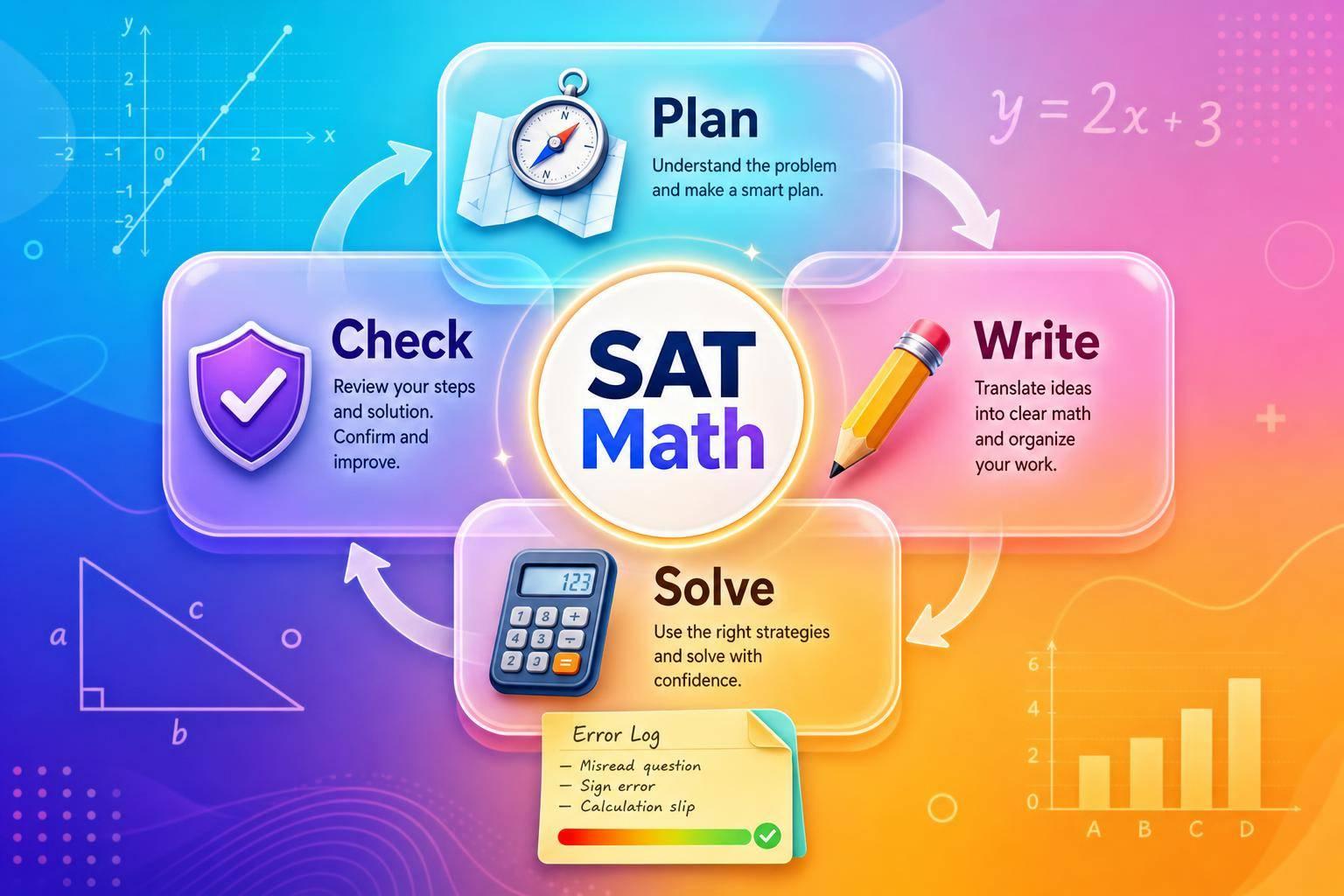
How to Combine Skills for SAT Math Success
Most digital SAT Math questions are not one-skill questions. You often have to read data, write an equation, and solve it in the same problem. On the SAT, 98 total questions become 44 Math questions split across 2 modules, so your job is to spot the skill mix fast and keep your work clean.
Source for test structure: College Board digital SAT format pages.[1][2]
Here’s the short version of what I’d do:
- Plan: mark what the question wants
- Write: turn the facts into an equation, formula, or ratio
- Solve: do the math in order
- Check: test units, labels, and whether you answered the right thing
The most common mixed-skill patterns are:
- Algebra + Geometry → use the figure or formula, then solve
- Algebra + Data Analysis → read the graph/table, then build a model
- Geometry + Data Analysis → find a measure, then use it in context
A lot of wrong answers come from setup mistakes, not hard math. That’s why I’d track misses by:
- skill pair
- mistake type
- where the setup broke
If you want a simple way to review, tools like SAT Practice Bot can help with practice questions, explanations, answer review, and progress tracking. Pair that with your own error log, and you can see patterns much faster.
Bottom line: if you use the same 4-step routine on each mixed-skill question, you can cut down careless misses and move through the digital SAT Math modules with more control.
A Simple Workflow for Multi-Step SAT Math Problems
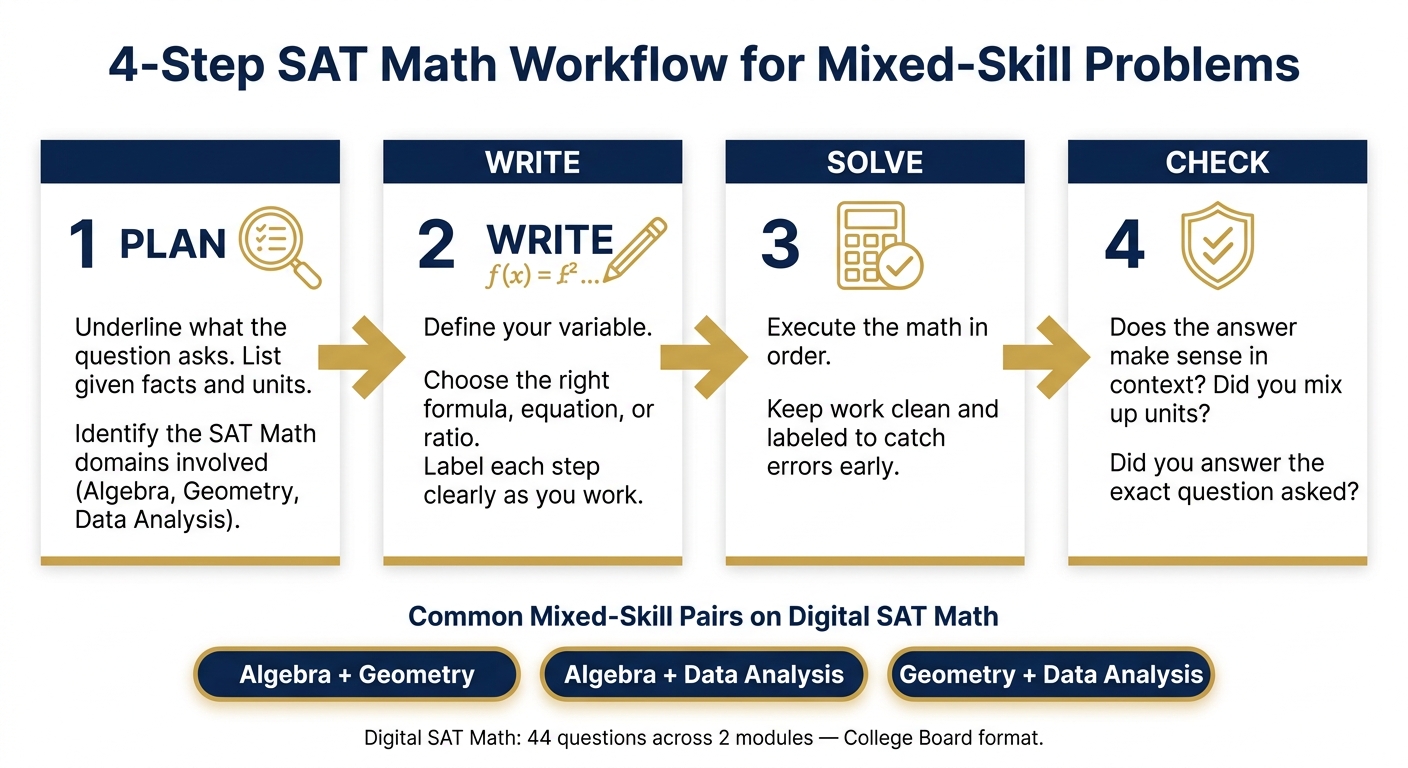
4-Step SAT Math Workflow: Plan, Write, Solve, Check
Use a four-step process - Plan, Write, Solve, Check - to stay organized on mixed-skill problems. It works well on algebra, geometry, and data analysis questions that take more than one step.
Plan: Identify the goal, the given information, and the domains involved
Read the problem twice before writing anything. Underline exactly what the question asks for - a value, a rate, a ratio, or an interpretation. Then list the given facts and note the units. That small habit can save you from solving for the wrong thing.
Next, sort the problem by SAT Math area. A table or graph usually points to Data Analysis. A shape, angle, or area points to Geometry. A variable usually means Algebra is part of the job. Naming the domains first helps you pick the right tool right away.
Write and Solve: Turn information into equations, formulas, or ratios
Once you know the goal and the domains, define your variable in writing. Then choose the relationship that links what you know to what you need: a formula, an equation, or a ratio.
Label your steps as you go. Clear, labeled work makes it easier to spot mistakes early. On longer problems, that can keep one small error from turning into a mess.
Check: Confirm units, scale, and what the answer represents
After you get an answer, stop for three quick checks:
- Does the answer make sense in context? A negative length in geometry or a percent above 100% in some data questions can be a warning sign.
- Did you mix up units or scale? Feet and inches, miles and yards, or seconds and minutes are easy to confuse when the clock is running.
- Did you answer the right question? If the problem asked for a rate but you found a total, you still have one more step.
Use this process on the mixed-skill problems that show up often on SAT Math.
FAQ
When should I use this workflow?
Use it on problems that combine skills or take more than one move.
Do I need to write every step?
No. Write enough to track your thinking and check your work.
What should I check first at the end?
Start with units and what the question asked for. Those are common slip-ups.
How to Work With the Most Common SAT Math Skill Pairs
On digital SAT Math, questions often mix two skills in one problem. A good way to handle that is Plan-Write-Solve-Check. Use SAT Practice Bot practice sets and explanations to track recurring skill pairs and spot patterns [1]. For each pair, identify the first skill, then use the second to finish and check the answer [3].
These pairings show how SAT Math combines skills in practice.
Algebra and Geometry: Set up the formula, then solve for the unknown
Start by finding the geometric rule in the problem. That might be the area of a circle, the slope of a line on a graph, or the angle facts in a triangle. Once you have that relationship, switch to algebra and solve for the missing value.
Think of it like this: geometry tells you what equation to write, and algebra helps you finish the job. If the problem gives a diagram, mark the known values first so you don’t lose track of what the figure is saying.
Algebra and Data Analysis: Read the table or graph, then build a model
Begin with the data. Read the table, graph, or scatterplot carefully and look for the pattern: Is it increasing at a steady rate? Does it show a starting value and a rate of change? Then write the equation or model that fits the data.
After that, use algebra to solve what the question asks. You may need to plug in a value, solve for a variable, or compare two parts of the model. A lot of mistakes happen before the math even starts, so slow down and read the axes, labels, and units.
Geometry and Data Analysis: Find the measure, then apply it in context
First, find the geometric measure, such as length, area, angle, radius, or volume. Then use that result in the data or word-problem setting the question gives you.
This second step matters. A problem may ask for a value based on your measure, not the measure itself. For example, you might find the radius first, then use it to read a chart, compare rates, or choose the answer that fits the situation. Match your final answer to exactly what the question asks.
Practice Mixed Skills and Learn From Errors
Skill pairs matter most when you have to use them under time pressure. That’s why mixed practice works better than isolated drills. Instead of doing ten problems of the same type in a row, work on short sets that make you switch gears. That feels much closer to the digital SAT.
Build short practice sets that mix two or more domains
Create short sets around the pairings you’ve already flagged, like Algebra + Data Analysis or Geometry + Algebra. The goal is to practice moving from a graph or table to an equation, then doing the reverse on the next question. That back-and-forth is where many students get stuck.
Include a range of difficulty levels:
- easy questions to lock in the basics
- medium questions to practice switching between skills
- hard questions to test whether you can stay accurate when the setup gets less obvious
That mix keeps the practice realistic and helps you get used to the way digital SAT math questions can shift from one idea to another.
Use an error log to find weak skill combinations
After each set, review every missed question. Then log each miss by skill pair and mistake type. This makes your review much more useful than just marking something wrong and moving on.
| Mistake Type | What It Means |
|---|---|
| Setup error | You misread the problem or used the wrong approach from the start |
| Wrong formula | You chose an incorrect rule or relationship |
| Calculation error | Your setup was right, but the arithmetic went wrong |
| Misread graph or units | You pulled the wrong value from a table, graph, or axis label |
After a few sessions, patterns start to show up. Maybe most of your Algebra + Data Analysis misses come from setup errors. Maybe your Geometry + Data Analysis misses come from unit mix-ups. That gives you a clear next step: fix the pattern, not just the single question.
Use SAT Practice Bot to review explanations and track patterns
A review tool can save time here by keeping explanations and performance trends in one place. SAT Practice Bot can support this workflow with curated practice questions, explanations, answer review, and progress tracking.
The main benefit is simple: explanations show where your thinking went off track, and progress tracking helps you notice repeat trouble spots in mixed-skill questions. When you pair that with your own error log, it becomes much easier to see why you’re missing questions, not just which ones you missed.
Conclusion: A Repeatable Method for SAT Math Accuracy
SAT Math problems often combine two or more skills, so your job is to spot that mix fast. Once you see what the question is asking for, stick to the same routine each time.
Use Plan, Write and Solve, and Check to work through mixed-skill questions in a clear order.
When you review, use that same routine again. Track missed questions by skill pair and mistake type so you can see where the problem began, not just where the final answer went wrong.
Then use your error log to shape your next practice set. SAT Practice Bot supports review with practice questions, explanations, and progress tracking.
Accuracy comes from repeated practice and careful review. The method is simple, and your results grow with steady work.
FAQ
What should I track in an SAT Math error log?
Track the skill pair in the question, the mistake type, and where your work broke down.
Why do mixed-skill questions feel harder?
They often ask you to connect ideas, not just use one formula or one step.
How should I use SAT Practice Bot for review?
Use it to practice questions, read explanations, and track your progress over time.