
SAT Practice Test 2: Reading Section Explained
Most SAT Reading mistakes come from choosing answers that sound right instead of tracing exact textual evidence—use a 4-step review.
Try a question now. No account needed.
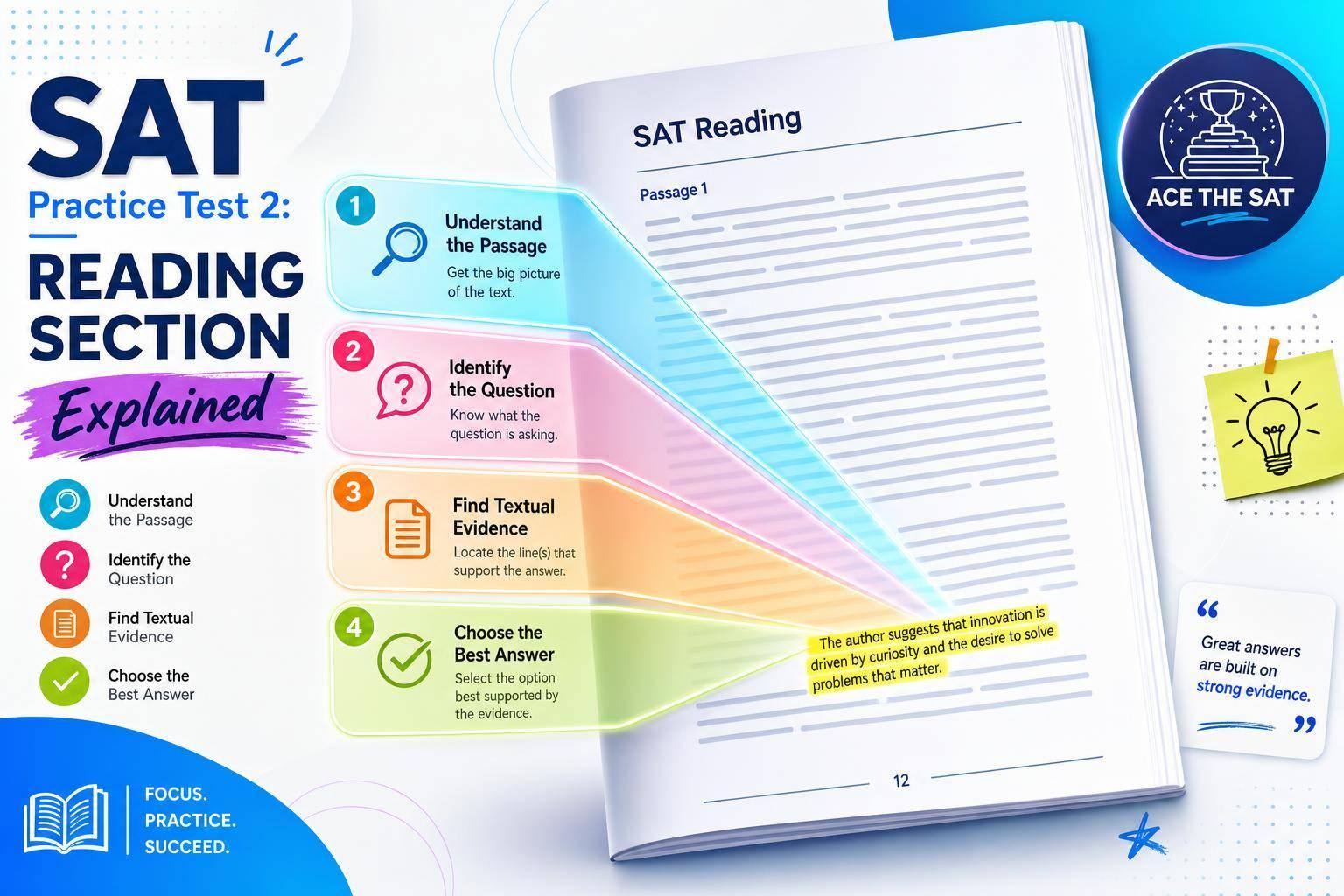
SAT Practice Test 2: Reading Section Explained
Most SAT Reading and Writing misses come from one issue: picking an answer that sounds right without checking the exact words in the passage or chart. If I use Practice Test 2 the right way, I can turn each miss into a rule for my next test.
Here’s the short version:
- Information and Ideas: I need direct support from the text.
- Craft and Structure: I need to watch small wording shifts.
- Expression of Ideas: I need the choice that fits the sentence and the full context.
- Paired texts: I should keep each author’s view separate before comparing.
- Graphs and tables: I must match the answer to both the visual and the passage claim.
A good review method is simple:
- Name the skill.
- Find the exact proof.
- See why my answer was wrong.
- Write one short rule for next time.
On the digital SAT, every Reading and Writing question has 4 answer choices, and the section is built around short passages and skill-based tasks, according to the College Board. That means my review should focus less on the letter I picked and more on why the text supports one choice and rules out the other three.
This guide is best used as a review map, not just an answer check. If I slow down, trace the proof, and label my error pattern, one practice test can do a lot more than show me a score.
The Main Question Types in SAT Practice Test 2
Review Practice Test 2 by skill. First, figure out what each missed question was testing. Then read the explanation to see why the right answer fits. SAT Practice Bot is free at $0 during beta, with unlimited curated digital SAT practice and no monthly cap; Full-length timed exams and paid Pro enrollment are not currently open.[1][2].
With that approach in place, Practice Test 2 falls into three main skill buckets. Information and Ideas focuses on support. Craft and Structure focuses on wording. Expression of Ideas asks whether a revision fits the sentence and the larger context.
Use this quick map as you work through the explanations below.
| Skill Area | Main challenge | Watch for |
|---|---|---|
| Information and Ideas | Choosing an answer that sounds plausible but does not have support in the text | Trace the right answer back to the passage |
| Craft and Structure | Missing small wording differences | Even tiny shifts in wording can change the meaning |
| Expression of Ideas & Conventions | Missing the pattern behind a revision question | Use the explanation to spot which revision best fits the sentence’s meaning and context |
Question-by-Question Explanations for SAT Practice Test 2
Use the skill map above in the same order as your missed questions. First, name the question type. Next, spot the trap. Then check the proof. For each miss, pin down the skill, the trap, and the exact proof in the text. That process helps you follow the evidence and rule out wrong choices.
Single-Passage Questions: From Misread Detail to Correct Evidence
For single-passage questions, connect every answer choice to a specific word, line, or detail in the passage. Wrong answers often take one small detail and stretch it too far. Stick to what the text actually says, and pick the answer that has direct support.
Cross-text questions add one more step: compare both authors before you choose.
Paired Texts and Cross-Text Questions: Agreement, Contrast, and Extension
Paired-text questions ask you to compare both passages with care instead of blending them into one argument. Find each author’s main point, then match the answer to the way the two texts connect. The right answer needs support from both passages.
If there’s a chart, use the same approach, but check the answer against the visual too.
Graph and Table Questions: Matching Visual Data to the Passage Claim
Graph and table questions ask for an answer that fits both the visual data and the passage claim. Start with the data point, then confirm that it supports the claim in the question. The correct answer has to match both.
Common Mistakes in SAT Practice Test 2 and How to Fix Them
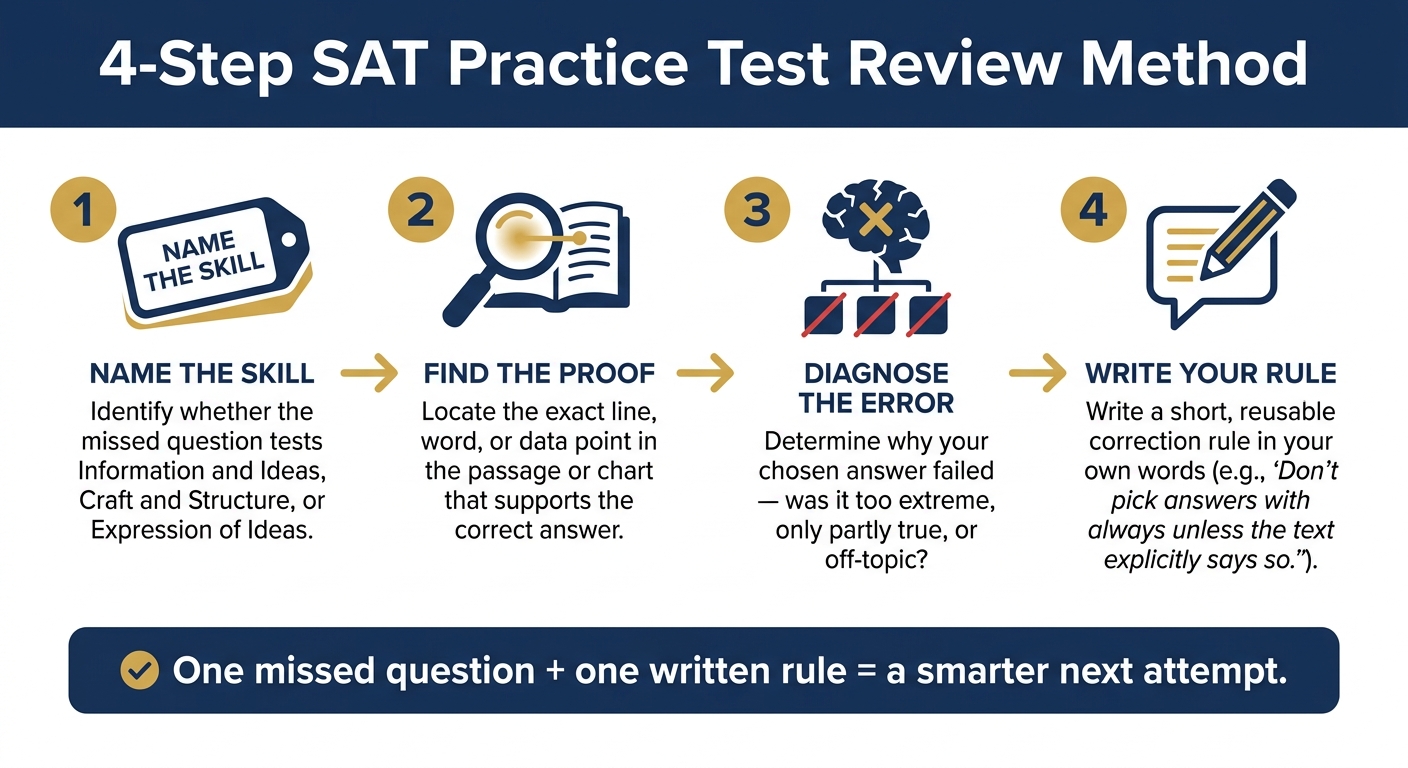
4-Step SAT Practice Test Review Method
Wrong-Answer Patterns That Come Up Most Often
After you check each question, group your misses by the trap they have in common.
Practice Test 2 brings back a few predictable traps. If you can spot them, you’re less likely to miss the same kind of question again.
| Question Type | Common Mistake | Fix |
|---|---|---|
| Information and Ideas | Choosing an answer with partial support but missing key evidence | Confirm every part of the answer has direct support in the passage |
| Craft and Structure | Choosing wording that sounds natural but misses the sentence's purpose | Ask what the author is doing in that sentence, not just what it says |
| Paired Texts | Treating two separate positions as one | Identify each author's position separately before comparing |
| Graph and Table | Using the passage alone and ignoring the chart | Check the claim against both the text and the chart before committing |
Two habits make these traps worse: skipping exact evidence and missing key words. Slow down and match the wording exactly. When you review, label each miss by pattern before you move on.
Watch out for extreme words like always, never, or proves unless the passage is just as certain. On the digital SAT, the best answer usually matches the text’s exact claim, not the strongest-sounding one.
A Simple Review Method for Better Scores on the Next Attempt
Once you know the trap, turn each miss into a rule you can use later.
After grading Practice Test 2, review every missed question with this four-step method:
- Name the tested skill: Information and Ideas, Craft and Structure, or Expression of Ideas.
- Find the exact line or sentence in the passage that supports the correct answer.
- Figure out why your choice failed. Was it too extreme, partly true, or off-topic?
- Write a short correction rule you can reuse, such as: Don't pick answers with always unless the text explicitly says so.
Write the rule in your own words. That makes it easier to remember on your next test.
SAT Practice Bot can help by giving detailed explanations for missed questions and tracking recurring error patterns across sessions [1][2].
Quick example: If you miss a question because an answer choice sounds nice but does not match the author’s purpose, your rule might be: Focus on function, not just wording.
FAQ
Should I review only the questions I got wrong?
No. Also look at questions you guessed on or answered with low confidence.
What if two answers both seem partly right?
Go back to the passage and test each part of the choice. On the SAT, one small mismatch is enough to make an answer wrong.
How long should review take?
Usually longer than the test itself. The point is to find the pattern behind the miss, not just mark the right letter.
Conclusion: What SAT Practice Test 2 Teaches You About SAT Reading and Writing
After you score Practice Test 2, use those results to shape what you do next. The test helps most when you review why you missed each question, not just which question you missed. For every question type, tie the correct answer to the exact words, lines, or data in the passage or chart, then write down the error pattern you made.
That simple habit can turn one practice test into a repeatable way to get better.
Detailed explanations show why each answer is right or wrong [1], and more practice helps you apply those lessons as you improve [2].