
How to Compare Opposing Arguments on the SAT
What an opposing argument is, and a 3-step method to compare two SAT arguments by claim, evidence, and assumptions without falling for trap answers.
Try a question now. No account needed.
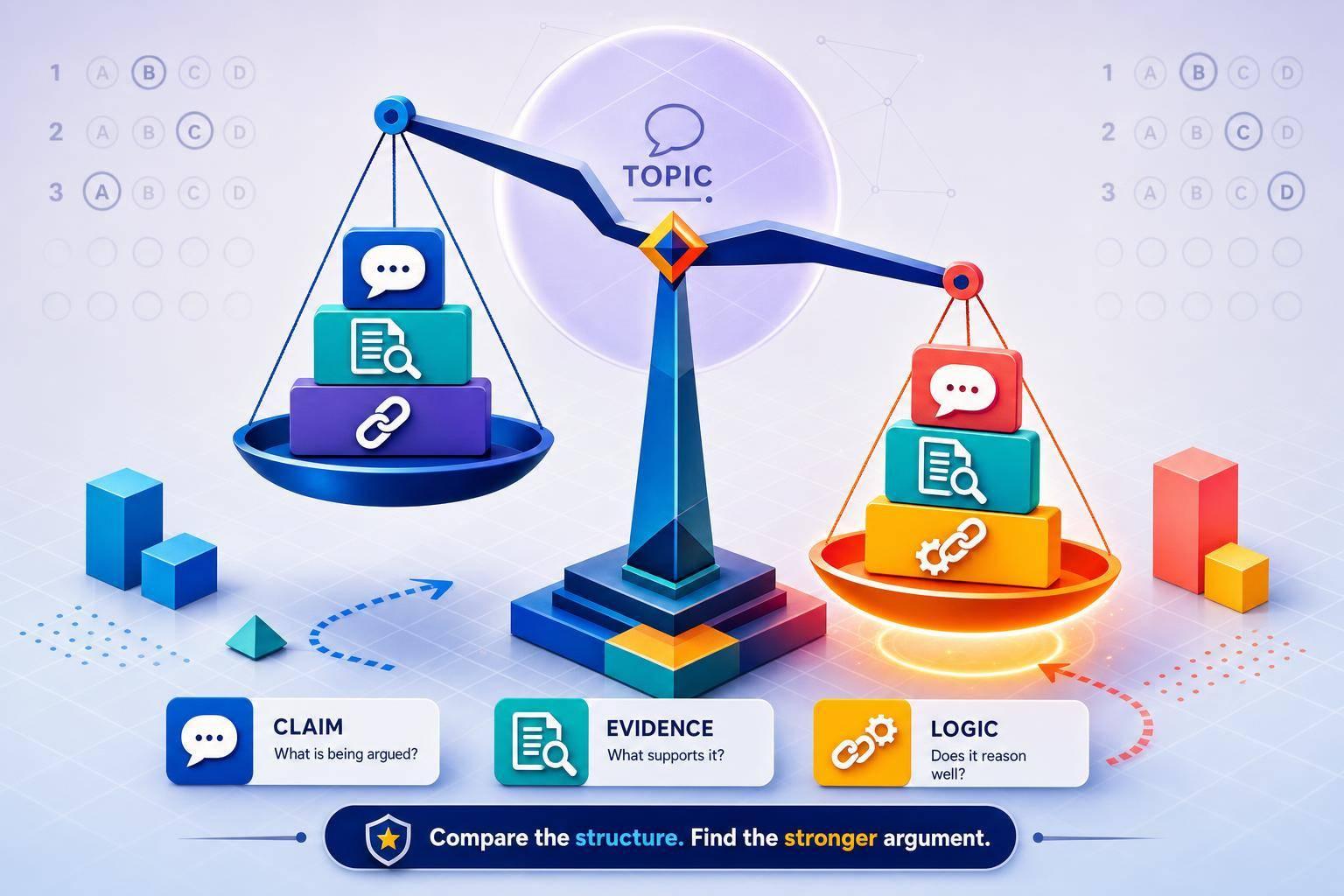
How to Compare Opposing Arguments on the SAT
An opposing argument is a position that disagrees with another claim on the same issue. On the SAT, two-text and argument questions ask how authors’ views relate. Map each author’s claim and support, note where they agree or disagree, then choose the answer the evidence in both texts supports.
Most SAT argument questions come down to 3 moves: map each author’s claim, check the support, and compare the gaps. If I keep those steps separate, I make fewer trap-answer mistakes and judge the stronger argument faster.
Here’s the short version I’d use on test day:
- Write each claim in one line
- List the reason and evidence for each side
- Separate fact from opinion
- Watch for missing links
- Compare agreement, disagreement, and overlap
- Pick the answer that matches the text exactly
According to College Board, the digital SAT has 2 sections and uses short reading sets in Reading and Writing, so clear note-taking matters when I move passage to passage fast. The goal is not to pick the louder argument. The goal is to pick the one with better proof and cleaner logic.
Quick Comparison
| What I compare | What I look for | Common mistake |
|---|---|---|
| Claim | What each author says is true | Mixing up topic with position |
| Reasons | Why the author thinks the claim is true | Listing details without linking them to the claim |
| Evidence | Facts, data, examples, or expert views | Treating opinion like proof |
| Logic | Whether the support leads to the conclusion | Missing a gap in reasoning |
| Answer choices | Exact match to the passage | Falling for extreme words like always or never |
Bottom line: if I compare claim, support, and logic side by side, I can spot where the authors split and which argument holds up better.
FAQ
What does the SAT usually ask me to compare?
I should look for agreement, disagreement, evidence differences, and which claim is better supported.
What is the fastest note system?
A short Claim-Reason-Evidence map for each author.
What trap answer shows up a lot?
An answer that says something true from the passage but does not answer the actual question.
Where can I practice this skill?
I can use short digital SAT Reading and Writing sets and track misses by type. SAT Practice Bot offers digital SAT Reading and Writing practice, answer explanations, and progress tracking.
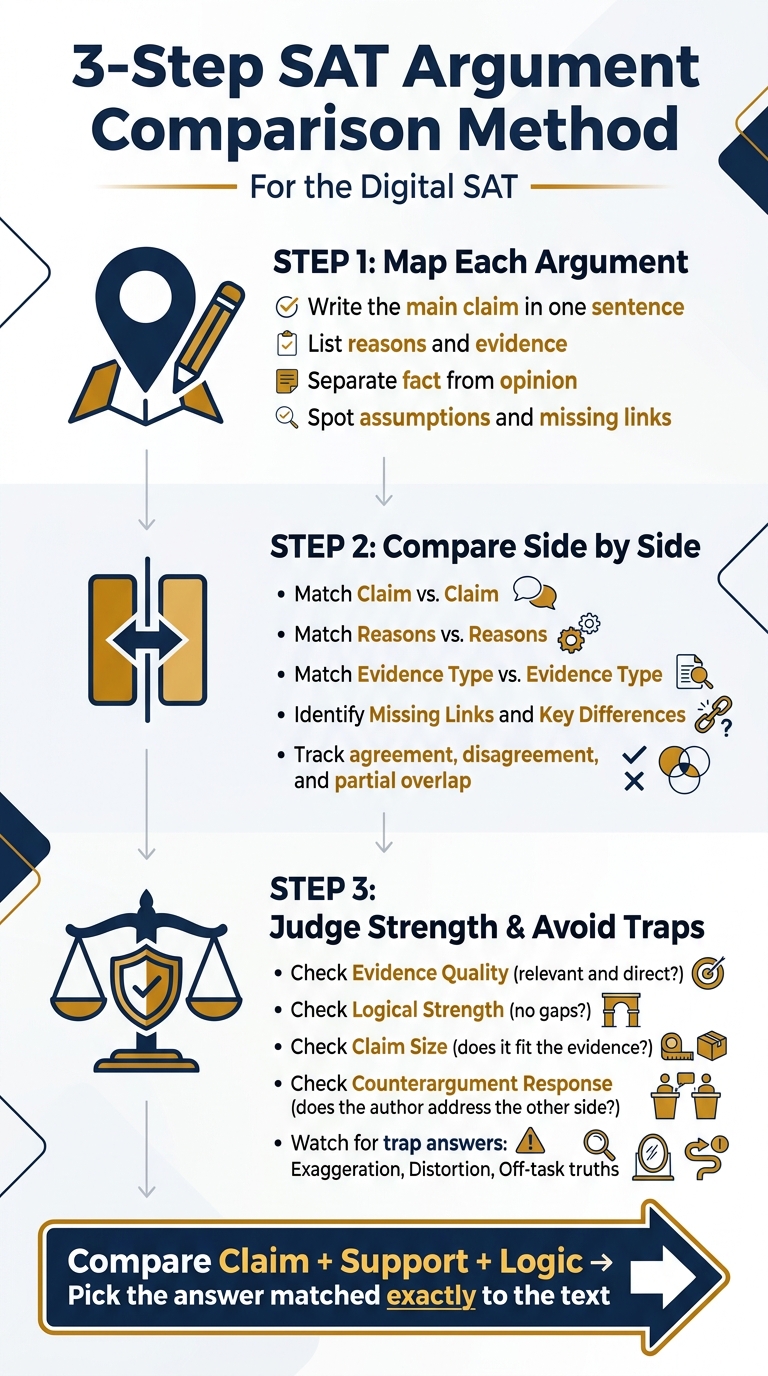
3-Step SAT Argument Comparison Method
What does “opposing argument” mean?
An opposing argument (or counterargument) is the case against a claim. On the SAT you won’t be asked to define the term. Instead, Cross-Text Connections questions ask how Text 2’s author would respond to Text 1. Decide whether they fully disagree, partly agree, or are answering a different question.
Keep practicing with Cross-Text Connections practice, Text Structure and Purpose, and Rhetorical Synthesis.
Step 1: Map Each Argument Before You Compare
Before you compare two arguments, map each one on its own. This makes weak spots and strong points much easier to see. It also saves time on the digital SAT, where clear notes can help you move faster with fewer mistakes. Start with the claim, then follow the support.
Find the Main Claim and Supporting Reasons
Write the claim in one sentence. Then list the reasons behind it and the evidence used to back it up. This is the fastest way to pin down what each side is saying. Once the claim is clear, the rest of the argument is much easier to sort.
Separate Evidence From Opinion
Label evidence as facts, examples, or research. If a statement has no support, treat it as opinion. On the SAT, weak support is often dressed up in confident wording. That’s why the next step matters: check whether the evidence actually proves the claim.
Spot Assumptions and Missing Links
An assumption is an idea the argument relies on but never says out loud. If the support doesn’t quite get you to the claim, that gap matters. On the SAT, that gap is often where the question is hiding. Missing links are a strong clue that one argument is weaker.
Step 2: Compare the Two Arguments Using a Simple System
Once you’ve mapped each argument, put them next to each other. This helps you see where the authors agree, where they split, and which one does a better job proving the point.
Compare Claims, Reasons, and Evidence Side by Side
Write each author’s position in one sentence, then match the support under it. Pay attention to the kind of support each writer uses: data, logic, examples, or expert opinion.
| Aspect | Author 1 | Author 2 |
|---|---|---|
| Main Claim | One-sentence summary of their position | One-sentence summary of their position |
| Reasons | Why they believe the claim is true | Why they believe the claim is true |
| Evidence Type | Facts, data, examples, expert opinion, or logic | Facts, data, examples, expert opinion, or logic |
| Missing Link | Where the support fails to reach the claim | Where the support fails to reach the claim |
| Key Difference | What sets this argument apart from the other | What sets this argument apart from the other |
Fill this in fast as you read. Your notes don’t need to look polished. A few rough words in each box can stop the two arguments from blending together when the clock is ticking.
Track Agreement, Disagreement, and Partial Overlap
Two authors can write about the same topic and still push for different answers. Don’t mix up shared facts with shared conclusions. Keep the topic separate from the claim.
For example:
Same topic, different claim
Same goal, different method
That small distinction matters a lot on the digital SAT. It makes it much easier to spot which argument has stronger support and where one author leaves a gap in the reasoning.
Step 3: Judge Which Argument Is Stronger and Avoid Trap Answers
Once you’ve mapped both arguments, decide which one has better support. Your side-by-side notes from Step 2 help you do this fast.
Use Clear Standards to Judge Argument Strength
Use four simple checks: the quality of the evidence, the logic, the size of the claim, and whether the writer deals with the other side.
| Criterion | What to Look For | Weak Sign |
|---|---|---|
| Evidence Quality | Relevant evidence that directly supports the claim | Vague details or examples that do not prove the point |
| Logical Strength | Reasons that lead clearly to the conclusion | Gaps between the evidence and the conclusion |
| Claim Size | A conclusion that fits the evidence given | A broad claim with thin support |
| Counterargument Response | Noticing and answering the other side | Ignoring the opposing argument |
Don’t get fooled by bold wording. Stronger language does not mean stronger reasoning. Compare the support, then check whether an answer choice goes too far beyond what the passage says.
Common SAT Answer Traps to Watch For
Wrong answers often twist a real detail just enough to sound correct.
- Exaggeration: The passage says something works in some cases, but the answer choice turns that into always.
- Distortion: The choice keeps one true detail but changes its meaning or pulls it out of context.
- Off-task truth: The choice says something true from the passage, but it does not answer the question.
That last trap gets a lot of students. You read it and think, “Yes, that was in the text.” But the Digital SAT cares about the task, not just whether the line sounds familiar.
Practice the Method and Review Your Results
A Short Practice Routine for Better Accuracy
Use short daily drills so the three-step method starts to feel automatic.
Each day, do 3–5 argument-focused Reading and Writing questions. For each passage, make a quick Claim-Reason-Evidence map by hand before you check the answer choices. That small step keeps your notes tied to the argument instead of the general topic. After you grade your work, label each miss: misread claim, confused opinion with evidence, or topic-only trap.
Use a platform that lets you practice, review answers, and track errors in one place. SAT Practice Bot offers digital SAT Reading and Writing practice, answer explanations, and progress tracking so you can spot recurring mistakes.
Key Points to Remember on Test Day
Keep the process simple on test day. Keep each claim separate, compare support rather than topic, track exact agreement or disagreement in the logic, and choose only answers that are directly supported by the text.