
Question Stem Check for SAT Answer Elimination
A 4-step SAT stem-check: identify the task, match units/evidence, meet all requirements, and eliminate mismatched answers.
Try a question now. No account needed.

Question Stem Check for SAT Answer Elimination
Before I choose an SAT answer, I check that it answers the exact question - not just something related. I use four checks: identify the task, match the units or source, meet every requirement, and rule out choices that fail.
- Math: I check the requested quantity, units, conditions, and answer format. If a value goes from 80 to 100, the increase is 25%, not 20.
- Reading and Writing: I use the named text, notes, or graphic to check support, meaning, and the revision’s purpose.
- Before submitting: I reread the stem and check my entry for student-produced responses.
- After practice: I label each mistake by the check I missed and write one fix for next time.
My rule: <u>check what the question asks before judging the answer.</u>
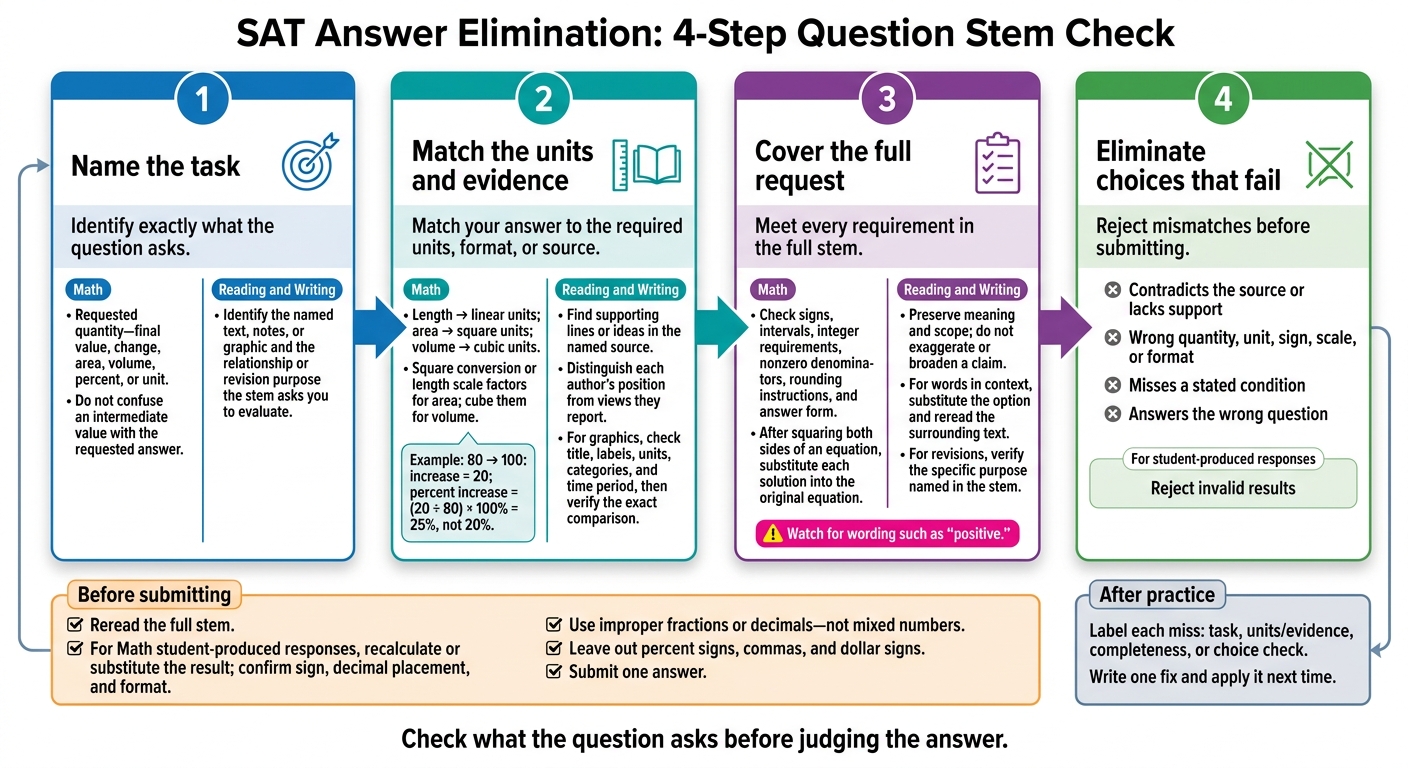
SAT Answer Elimination: 4-Step Question Stem Check
SAT Math: Check the Requested Quantity
In Math, start by identifying exactly what the question asks you to find.
Name the requested quantity: final value, change, area, volume, percent, or unit. Compare it with what you calculated. Eliminate any choice that gives only an intermediate value - even if your calculation is correct.
Checklist: Verify Units and Conditions
Match the units. Length uses linear units, area uses square units, and volume uses cubic units. When converting area or volume, square or cube the conversion factor.
Check the answer form. Does the question ask for a percent, decimal, fraction, change, or final value? For percent change, divide the change by the original value, then multiply by 100%. In geometry, square a length scale factor for area and cube it for volume.
Check the conditions. Verify signs, intervals, integer requirements, nonzero denominators, and rounding instructions. After squaring both sides of an equation, substitute each solution into the original equation. Reject values that break the question’s conditions or don’t make sense in context. If the question asks for a value, stop once your result matches that request.
Use these checks for both multiple-choice and student-produced responses. Rule out wrong quantities, signs, or scales before submitting your answer.
SAT Reading and Writing: Check the Source
Use the question stem to identify which source to check and what relationship matters. Then test each answer choice against that source only.
Checklist: Match Evidence and Meaning
Find the support. Once you understand the task, locate the line or idea that supports each remaining choice. In paired texts, distinguish each author’s position from views they report.
Read the graphic directly. For data questions, read the graphic before judging the choices. Check its title, labels, units, categories, and time period. Then verify the exact comparison the claim requires.
Preserve meaning and scope. Reject answers that exaggerate, broaden, or misread the source’s claim. For words in context, substitute each option and reread the surrounding text. Choose the word that fits the author’s tone and meaning.
Check the revision’s job. When the stem asks for a revision, focus on its purpose. For transitions, rhetorical synthesis, and grammar questions, use the provided text or notes to check whether the choice does the specific job the stem names.
Before Submitting: Check the Full Stem
Checklist: Confirm Nothing Is Missing
Reread the full stem. Check that your answer matches the task, limits, and exact wording. Does it address every part without relying on an unstated assumption?
Watch for wording such as positive.[8]
For Math student-produced responses (grid-ins), check your entry before submitting. Confirm the sign, decimal placement, and format. Enter improper fractions or decimals - not mixed numbers - and leave out percent signs, commas, and dollar signs.[7][1]
Check the stem before reviewing the answer choice itself.
Checklist: Eliminate Choices That Fail
Eliminate any choice that:
- Contradicts the source or lacks support.
- Uses the wrong quantity, unit, sign, scale, or format.
- Misses a stated condition.
- Answers the wrong question.
Catch these mismatches before moving into the 4-step answer review that follows.
Conclusion: Use a 4-Step Final Check
Before you submit, run the same four checks: name the task, match the units and evidence, cover the full request, and eliminate choices that fail.
For student-produced responses, recalculate or substitute your result to check it. Then confirm your entry and submit one answer.[7]
Use the Checklist During Answer Review
After grading, label each missed question by the check it failed: task, units/evidence, completeness, or choice check. Write one fix beside each miss, and apply it next time.
Use SAT Practice Bot’s answer review and progress tracking to label each miss by its failed check.[9]
FAQs
How can I check the stem quickly under time pressure?
Before reading the answer choices, restate what the question asks. Identify keywords and the goal: finding a purpose, locating a detail, or doing a calculation [1]. Then predict the answer - solve, estimate, or identify the expected tone or detail - so the choices don’t steer your thinking [1][2][3]. Finally, check that your choice has direct support in the passage or math, stays within the question’s scope, uses the required units, and answers the entire question [1][4][5][6].
What if two answer choices seem supported?
Return to the passage and check every part of each answer choice against the evidence and the question. Even a small mismatch or an unsupported detail makes a choice incorrect.
If you find no more evidence, choose the answer with stronger overall support. Focus on the author’s main purpose rather than minor details. Still stuck? Mark the question for review and move on to keep your pace.
How can I avoid repeating stem-check mistakes?
Build a consistent routine. Before reading the answer choices, identify exactly what the question asks, mark keywords or line references if provided, and predict the answer. Before selecting a choice, confirm that the units match, the text evidence or your math supports it, and it answers the entire question.
Keep an error log that names each mistake, such as misreading a prompt or missing a concept. Look for patterns, then turn repeated mistakes into clear rules to use in your next practice session.