
SAT Math: Systems of Inequalities Study Guide
Graph boundary lines, shade correct sides, and test points to find overlapping regions—clear SAT strategies for systems of inequalities.
Try a question now. No account needed.

SAT Math: Systems of Inequalities Study Guide
If you can graph two boundary lines, shade the correct sides, and find the overlap, you can solve most SAT systems of inequalities questions. On the digital SAT, these questions often ask you to read a graph, test a point, or turn a word problem into inequalities.
Here’s the core idea in 3 steps:
- Draw the boundary line
Use a solid line for ≤ or ≥. Use a dashed line for < or >. - Shade the correct side
Test a point like (0, 0) if it is not on the line. - Find the overlap
The answer is the region that fits all inequalities.
What I’d keep in mind for test day:
- A system of inequalities usually gives a region, not one point.
- If I multiply or divide by a negative, I must flip the inequality sign.
- In word problems, phrases like “at least” mean ≥, and “at most” means ≤.
- A point is a solution only if it makes every inequality true.
- On the digital SAT, the built-in graphing tool can help me check lines and shaded regions. College Board describes graphing tools as part of the current digital testing experience on math questions where they are available.
A fast way to work is: simplify → graph → test one point → check the overlap.
If I want extra practice on this skill, I can use SAT Practice Bot for targeted drills and explanations on systems of inequalities.
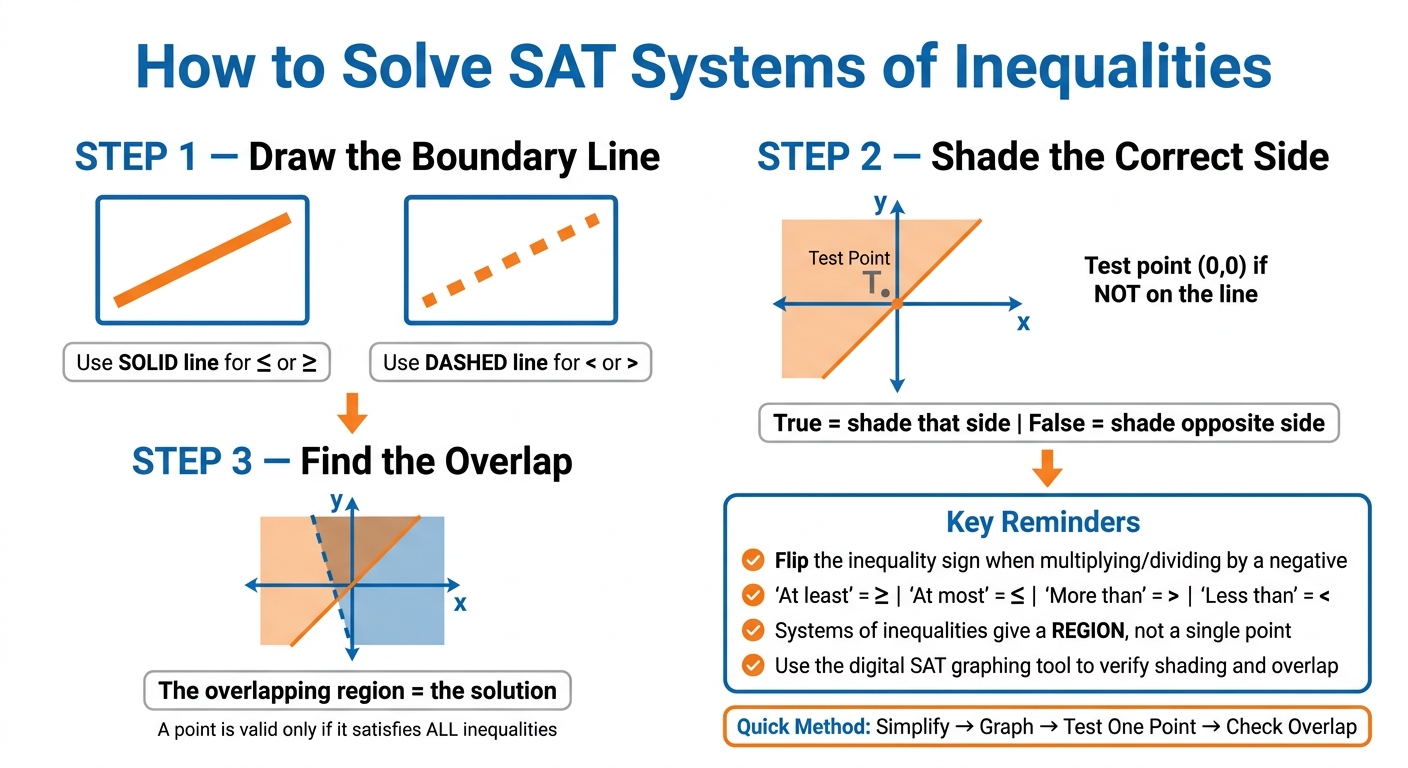
How to Solve SAT Systems of Inequalities: 3-Step Visual Guide
How to Graph and Solve Systems of Inequalities
Turn the shaded regions into a solution by finding the area they share.
How to graph a single inequality correctly
Start with the boundary line. If the inequality uses ≤ or ≥, draw a solid line. If it uses < or >, draw a dashed line. Then shade the side where the inequality is true. After you graph both inequalities, the overlap of the shaded parts is the solution.
How to find the overlap in a system
Once each inequality is shaded, look for the region they share. That shared region is the solution to the system. A point works only if it sits in that region and makes every inequality true.
How to use graphing tools on the digital SAT
On the digital SAT, the graphing tool can help you plot boundary lines and check the overlap more fast. Use the built-in graphing tools to graph each boundary line and inspect the shared shaded region. This can save time when you want to test whether a point falls in the solution set.
How to Translate Word Problems into Inequalities
When the SAT gives you rules in words, turn them into inequalities before you graph anything or plug in answer choices. Start by defining each variable, and include the units. Then write one inequality for each rule. Your job is to convert the wording into a system you can graph or test.
Common phrases and the inequality symbols they signal
Some phrases are direct clues:
| Phrase | Symbol | Equality allowed? |
|---|---|---|
| at least / no less than | ≥ | Yes |
| at most / no more than | ≤ | Yes |
| greater than / more than | > | No |
| less than / fewer than | < | No |
Use ≥ or ≤ when the boundary counts. Use > or < when it does not.
How to build a system from money, quantity, and time constraints
Write each money, quantity, or time rule as its own inequality, then put them together into one system. Keep the units the same all the way through.
For example, if x is the number of notebooks and y is the number of folders, a cost limit, an item limit, and a time limit would each become separate inequalities. Think of it like stacking rules on top of each other: a point has to follow all of them, not just one.
How to check whether a point satisfies the system
After you translate the words into a system, test any point by substituting its x- and y-values into every inequality. A point works only if all the statements come out true.
If even one inequality fails, that point is out.
FAQ
What if a phrase says "at least"?
Use ≥ because equality is allowed.
What if a phrase says "more than"?
Use > because equality is not allowed.
Do I test a point in just one inequality?
No. Test it in every inequality in the system.
SAT Strategies, Common Mistakes, and Method Comparisons
Fast strategies for timed questions
Once you can graph and translate systems, start cutting steps. On the digital SAT, that matters.
Before you graph anything, simplify every inequality. It saves time and cuts down on small errors.
When you need to figure out which side of a boundary line to shade, use (0, 0) only if it is not on a boundary line; otherwise choose another easy point. Plug in 0 for both variables. If the statement is true, shade the side with the origin. If it’s false, shade the other side.
Systems of equations usually have a point solution; systems of inequalities usually have a region. That one idea helps you spot what the answer should look like before you finish. Use the graph tool to check the shaded side after a quick sketch.
Common mistakes that lead to wrong answers
The costliest mistake is flipping the inequality sign at the wrong moment. You must flip the sign whenever you multiply or divide both sides by a negative number. Miss that step, and your answer lands on the wrong side of the line.
Another trap: rushing into the graph before the inequality is in a cleaner form. A few seconds of algebra up front can save you from fixing a messy sketch later.
Graphing vs. point testing vs. mixed methods: a comparison
Pick the method that makes the prompt easiest, not the method you used on the last question.
| Method | Best used when… | Watch out for… |
|---|---|---|
| Graphing only | Need to see the overlap | Can miss the correct region in a crowded graph |
| Point testing only | Need to check one coordinate | Does not show the whole solution set |
| Mixed (simplify → graph → test one point) | Need a fast confirmation | Still requires a clean sketch |
The mixed method is often the safest play under time pressure: simplify, sketch the boundary lines, then test an easy point to check the shaded side.
Example: If a line goes through the origin, don’t test (0, 0). Pick something simple like (1, 0) or (0, 1) instead.
Short FAQ
Do systems of inequalities usually give one answer point?
No. They usually give a region where the inequalities overlap.
When do I flip the inequality sign?
Flip it when you multiply or divide both sides by a negative number.
Is graphing alone always enough?
Not always. If the graph looks crowded, a quick point test can help check your work.
Practice Plan and Key Takeaways
What to remember before test day
Draw each boundary line. Use a solid line for ≤ or ≥ and a dashed line for < or >. Then shade the overlapping region. Test one point to make sure you picked the correct side.
After test-day review, turn those same steps into a daily habit.
How to practice this skill consistently
Once you know the rules, use short practice sets until the process feels automatic. Use SAT Practice Bot for targeted practice on systems of inequalities. Check each explanation right away so boundary lines, shading, and overlap regions stick. Then move from single inequalities to systems and word problems as your accuracy gets better.